
Comprendre le rapport génétique de votre enfant
Lorsque vous recevez pour la première fois un rapport génétique sur votre enfant, vous pouvez avoir l’impression qu’il est rédigé dans une langue complètement différente.
Mots longs. Chaînes de lettres et de chiffres. Des tableaux remplis de codes qui semblent impossibles à comprendre.
Beaucoup de parents nous disent la même chose :
« Nous avons le rapport… mais nous ne comprenons pas vraiment ce que cela signifie. »
Si cela vous semble familier, vous n’êtes pas seul.
Ce guide est là pour vous aider à comprendre les parties clés d'un rapport génétique, afin que vous puissiez vous sentir un peu plus en confiance en le lisant — sans avoir besoin de devenir scientifique.
Le but n’est pas de décoder chaque chiffre ou détail technique. Au lieu de cela, nous voulons vous aider à reconnaître les principales informations, à comprendre le type de changement génétique que votre enfant présente dans le Gène NARS1, et sachez où trouver du soutien supplémentaire.
Un bref récapitulatif : ADN, gènes et chromosomes
ADN
L’ADN est le long code chimique qui contient toutes les instructions sur la façon dont le corps grandit et fonctionne. L'ADN est un alphabet simple de seulement quatre lettres : A, C, T et G.
Gènes
L'ADN est divisé en sections spécifiques appelées gènes. Elles sont comme des recettes individuelles écrites le long de l’ADN. Chaque gène indique au corps comment fabriquer une protéine spécifique qui accomplit une tâche importante.
Le Gène NARS1 fournit des instructions pour fabriquer la protéine NARS1, qui aide les cellules à construire d’autres protéines dont le corps a besoin.
Chromosomes
Les chromosomes sont comme des livres constitués d’ADN contenant de nombreux gènes. Les humains ont généralement tout leur ADN divisé en 46 chromosomes, disposé en 23 paires. Chaque parent apporte un ensemble de chromosomes (23) aux 46 chromosomes de l’enfant.
La plupart des gènes entrent en jeu deux exemplaires
Si l'une ou les deux copies d'un gène contiennent un changement important (appelé a variante), cela peut affecter le fonctionnement de ce gène et parfois conduire à un problème de santé.
Ce qu'un rapport génétique vous dit réellement
Bien que les rapports génétiques puissent paraître compliqués, ils répondent généralement à trois questions principales :
Quel gène est impliqué et où
Quel type de changement (variante) a été trouvé
Ce que les scientifiques croient actuellement que signifie le changement
Votre rapport comprendra normalement un tableau décrivant la ou les variantes identifiées.
Pour de nombreuses familles NARS1, il existe deux variantes, un hérité de chaque parent. Dans d’autres cas, une variante peut apparaître de novo, ce qui signifie que cela s'est produit spontanément chez l'enfant/autour de la fécondation de l'ovule.
Pourquoi certains rapports montrent une variante et d’autres en montrent deux
Il existe deux manières principales par lesquelles les variantes de NARS1 peuvent apparaître dans les rapports.
Variantes de novo
Parfois, une variante apparaît nouveau dans l'ADN de l'enfant, même si aucun des parents ne le porte dans ses cellules somatiques (non impliquées dans la reproduction).
C'est ce qu'on appelle un variante de novo.
Dans ces cas, le rapport ne peut que montrer une variante.
Variantes héritées
Si les deux parents sont porteurs d’une copie modifiée du gène, l’enfant peut hériter de deux variantes.
Parfois, ce sont:
La même variante dans les deux copies du gène (appelé autosomique récessif ou homozygote)
Deux variantes différentes (appelé composé hétérozygote)
Dans ces cas, le rapport montrera généralement deux lignes ou deux tableaux, un pour chaque variante.
La section variante peut sembler différente dans différents rapports
Chaque laboratoire formate les rapports légèrement différemment.
Certains rapports présentent les informations sous forme de tableaux. D’autres décrivent les variantes dans des paragraphes ou des puces.
La section décrivant la variante peut également apparaître sous des rubriques différentes selon le laboratoire ou le pays.
La plupart des rapports incluent des détails tels que :
le nom du gène
le description de la variante
le classification
le zygosité
le héritage
parfois coordonnées génomiques
Vous pourriez voir des titres tels que :
Variante
Détails de la variante
Variante de séquence
Recherche moléculaire
Découvertes génétiques
Interprétation des variantes
Variante détectée
Bien que la formulation puisse varier, les informations fournies sont généralement très similaires.
Si vous n'êtes pas sûr de ce à quoi fait référence une section, recherchez le nom du gène (par exemple NARS1) et le description de la variante c'est souvent le moyen le plus simple de s'orienter.
Un exemple de variante d'un rapport
Un rapport peut inclure un tableau qui ressemble à ceci :
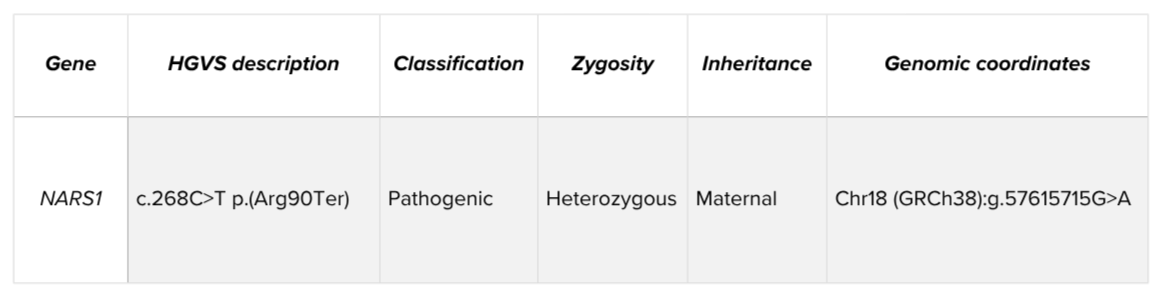
À première vue, cela semble compliqué, mais chaque partie décrit simplement un aspect différent de la variante.
Décomposons-le.
Comprendre la description de la variante HGVS
La description de la variante suit des règles internationales appelées Nomenclature HGVS.
Bien qu'il semble technique, il contient généralement deux parties clés :
un Changement au niveau de l'ADN
un changement du niveau de protéines
Exemple:
NARS1 c.268C>T p.(Arg90Ter)
Le changement du niveau de protéines
La partie commençant par p. décrit ce qui arrive à la protéine que le gène produit normalement.
Les protéines sont constituées d’éléments constitutifs appelés acides aminés, qui sont écrits à l'aide de codes à trois lettres.
Exemple:
p.(Arg90Ter)
Cela signifie:
Arg
l'arginine, l'acide aminé qui était censé se trouver à cette position 90
la position au sein de la protéine Ter
un signal d'arrêt
Donc cela nous dit :
« En position 90, l'arginine a été transformée en signal d'arrêt. »
Ce type de changement est appelé un absurdité ou variante stop-gain.
Étant donné que les instructions s’arrêtent tôt, la protéine peut être incomplète et incapable de fonctionner correctement.
Parfois, le signal d'arrêt s'écrit comme suit
Ter
*
X
Ils veulent tous dire la même chose.
Le changement au niveau de l'ADN
La partie commençant par c. décrit le changement dans la séquence d'ADN du gène.
Exemple:
c.268C>T
Cela peut être décomposé comme suit
c.
cela nous indique que nous examinons la séquence d'ADN codante 268
la position dans le gène où le changement se produit C>T
la lettre ADN C a été remplacée par T
Cela signifie donc:
« En position 268 dans le gène NARS1, la lettre C a été remplacée par T. »
Vous pourriez également voir d’autres terminaisons au niveau de l’ADN telles que :
du
suppression (lettres supprimées) ins
insertion (lettres ajoutées) dup
duplication (lettres copiées) delins
lettres supprimées et remplacées par des lettres différentes
Par exemple:
c.250_253del
Cela signifie que les lettres aux positions 250–253 ont été supprimées.
Autres changements protéiques que vous pourriez voir
Variante de décalage de cadre
Exemple:
p.Lys84Serfs*12
Cela signifie:
la lysine en position 84 devient de la sérine
le cadre de lecture des changements protéiques
un signal d'arrêt apparaît 12 acides aminés plus tard
Un décalage de cadre est un peu comme supprimer une lettre au milieu d'une phrase, tout ce qui suit est lu de manière incorrecte.
Pour les protéines, cela donne généralement une protéine raccourcie et non fonctionnelle.
Variante de faux-sens
Exemple:
p.Arg412Gly
Cela signifie que l'arginine a été remplacée par la glycine en position 412.
Suppression
Exemple:
p.Lys84del
Cela signifie que l’acide aminé lysine en position 84 a été éliminé.
Comment lire votre variante
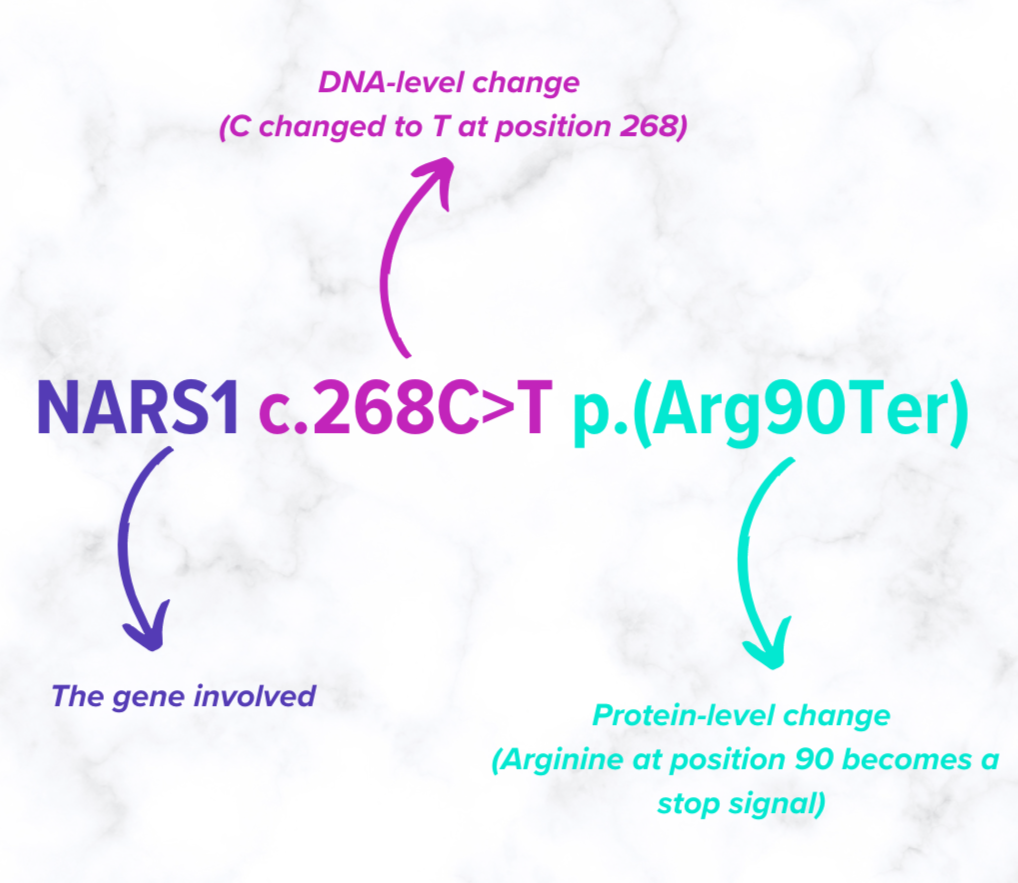
Maintenant que vous disposez de toutes ces informations, comment les utilisez-vous pour lire et comprendre votre variante ?
Ce diagramme met en évidence les éléments clés d’une description de variante afin que vous puissiez voir rapidement ce que signifie chaque partie.
Exemple:
NARS1 c.268C>T p.(Arg90Ter)
NARS1
le gène impliqué c.268C>T
le changement au niveau de l'ADN p.(Arg90Ter)
le changement du niveau de protéines
Comprendre les autres éléments de votre rapport
Zygosité : combien de copies sont affectées
Le rapport décrira également combien de copies du gène contiennent la variante.
Les termes courants incluent :
Hétérozygote
Une copie du gène possède la variante et l’autre non.
Homozygote
Les deux copies du gène contiennent la même variante.
Composé hétérozygote
Chaque copie du gène contient une variante différente.
De nombreux enfants atteints du trouble NARS1 sont hétérozygotes composés : deux variantes hétérozygotes — une dans chaque copie du gène.
Héritage : d'où viennent les variantes
Le rapport peut également indiquer d’où viennent les variantes. Cela nécessite que l'ADN parental soit séquencé avec celui de l'enfant.
Par exemple:
Maternel
hérité de la mère Paternel
hérité du père De novo
nouveau chez l'enfant et non présent chez aucun des parents dans les cellules somatiques
Des variantes héréditaires et de novo sont observées dans les familles NARS1.
Classification : ce que les scientifiques pensent que signifie la variante
Les laboratoires génétiques attribuent également une classification, ce qui reflète leur compréhension actuelle de la variante.
Les catégories courantes comprennent :
Pathogène - Provoquant des maladies.
Probablement pathogène - Très probablement pathogène.
Variante de signification incertaine (VUS) - Les scientifiques ne savent pas encore si la variante provoque une maladie.
Probablement bénin / bénin - Peu susceptible de provoquer des maladies.
Parce que Le trouble NARS1 est extrêmement rare et est toujours à l’étude, les classifications incertaines sont assez courantes.
Cela peut paraître troublant, mais cela reflète simplement que la science est encore en train d’apprendre.
À mesure que davantage de familles sont identifiées et que davantage de recherches sont menées, certaines variantes peuvent être reclassé au fil du temps.
C’est l’une des raisons pour lesquelles la Fondation Rory Belle travaille en étroite collaboration avec des familles et des chercheurs du monde entier — le partage d’informations contribue à améliorer la compréhension de NARS1.
Coordonnées génomiques : localisation GPS du génome
Certains rapports incluent également quelque chose appelé coordonnées génomiques, qui pourrait ressembler à ceci :
Chr18 (GRCh38):g.57615715G>A
Cela décrit exactement le même changement génétique, mais en utilisant la carte complète du génome humain.
En le décomposant:
Chr18
la variante est située sur le chromosome 18 GRCh38
la version du génome humain de référence utilisée par le laboratoire. g.57615715G>A
à la position 57 615 715 sur ce chromosome, la lettre ADN G est devenu A
Vous pouvez considérer cela comme le Coordonnées GPS de la variante dans le génome humain.
Les scientifiques et les laboratoires utilisent ces informations pour s'assurer qu'ils discutent de la exactement le même changement génétique lors du partage de données et de recherches.
Les parents n’ont généralement pas besoin d’utiliser cette ligne dans la vie de tous les jours, mais elle peut apparaître dans les rapports, il est donc utile de la reconnaître.
Vous n'avez pas besoin de tout comprendre
Les rapports génétiques sont complexes, même pour les professionnels.
Il est tout à fait normal que les parents se sentent dépassés lorsqu’ils les lisent pour la première fois.
Comprendre seulement quelques informations clés, telles que nom du gène, le description de la variante, et le classification, peut déjà rendre un rapport beaucoup plus gérable.
Si vous souhaitez en savoir plus sur le trouble NARS1 lui-même, vous pouvez lire notre guide :
Nous sommes là pour vous aider
Si vous n’êtes pas sûr de la signification du rapport de votre enfant, n’oubliez pas que vous n’êtes pas seul.
La Fondation Rory Belle est là pour soutenir les familles à chaque étape — du diagnostic à la compréhension de la science derrière NARS1.
Parfois, la première étape consiste simplement à demander à quelqu’un de vous aider à expliquer le rapport en langage clair.
S'il vous plaît contactez-nous si vous avez besoin de soutien
Dernier mot : comment le rapport génétique de votre enfant peut soutenir la recherche
Lorsque vous commencez à comprendre le rapport génétique de votre enfant, vous pouvez également entendre parler de son rôle dans la recherche.
Participer à la recherche est toujours un choix personnel, mais pour les familles qui souhaitent s’impliquer, le rapport génétique peut jouer un rôle important.
Le rapport de votre enfant aide les chercheurs :
Comprenez exactement quelle variante possède votre enfant
Cela permet aux équipes de recherche de concevoir des études, des tests et des thérapies potentielles adaptés à des changements génétiques spécifiques, sans que les familles aient besoin de se souvenir des détails complexes des variantes.Incluez votre enfant dans des plateformes de recherche et des études d’histoire naturelle
Ces études aident à dresser un tableau plus clair de la manière dont NARS1 affecte les enfants au fil du temps, ce qui est essentiel pour développer de futurs traitements.Mieux comprendre les modèles d’héritage
Lorsque des variantes sont héritées, ces informations peuvent aider les chercheurs à utiliser des échantillons parentaux comme comparaisons en laboratoire, renforçant ainsi la qualité de la recherche.
Au fil du temps, ces connaissances partagées contribuent à faire avancer la recherche, nous rapprochant ainsi d’une meilleure compréhension de NARS1 et du développement de futurs traitements.
Si vous souhaitez en savoir plus sur la façon de vous impliquer, vous pouvez visiter notre - Page d'études d'histoire naturelle
Il n'y a jamais de pression pour participer, mais si vous êtes intéressé, la Fondation Rory Belle peut vous guider à travers les options.